A silver wedding windmill cup
A silver windmill cup typical outline, the matted cuppa containing three ovals, two with engraved armorials and the other…
A silver-gilt, finely embossed presentation cup with lid, richly decorated with fruit motifs and acanthus leaves. The lid is crowned by a dove standing on a globe with the motto “Myn werck is hemelick” (“My work is heavenly”). The bowl consists of a cylindrical central section between two moulded swellings, decorated with cartouches of fruit alternating with acanthus leaves and frontal projecting cherub heads. Along the upper rim runs the inscription: “Desen Cop is ghemaeckt van prysen ghewonnen by die van dese ghilde 1661.” (“This cup is made from prizes won by those of this guild 1661.”) The baluster-shaped stem, enriched with cast volutes and fruit ornament, rests on a knop and a circular foot with corresponding decoration.

The Bruges chamber of rhetoric De Heilige Geest, to which this ceremonial cup belonged, was according to tradition founded on Maundy Thursday in 1428. On that day, during a memorial service of a local religious brotherhood, a dove flew into the chamber. The dove is said to have spoken the words “Myn werk is hemelick” (My work is heavenly), through which the brotherhood recognized the divine Holy Spirit in the bird. They then decided to continue under the name De Heilige Geest (The Holy Spirit), adopting the dove’s words as their motto. In the centuries that followed, De Heilige Geest grew to become the oldest and one of the most prominent chambers of rhetoric in the Low Countries.
Chambers of rhetoric were poetic and literary societies that played an important role in urban communities in the Low Countries during the late Middle Ages and the Renaissance. Every city had several of these chambers, whose members were typically creative and well-to-do citizens. The chambers were often commissioned by local authorities to enliven public celebrations and processions with songs, plays, and poetry. In this way, they played a significant role in shaping and expressing urban identity. In addition, annual poetry and drama competitions, known as landjuwelen (land jewels), were held between different chambers of rhetoric in the Low Countries. Unfortunately, few texts from the old rhetorical culture have survived, since they were occasional works not intended for long-term preservation. In the case of De Heilige Geest, it is further complicated by the fact that its archive was destroyed in a major fire in 1755. We do know, however, that De Heilige Geest produced influential Middle Dutch poets and playwrights such as Anthonis de Roovere (1420–1482) and Eduard de Dene (1505–1576).
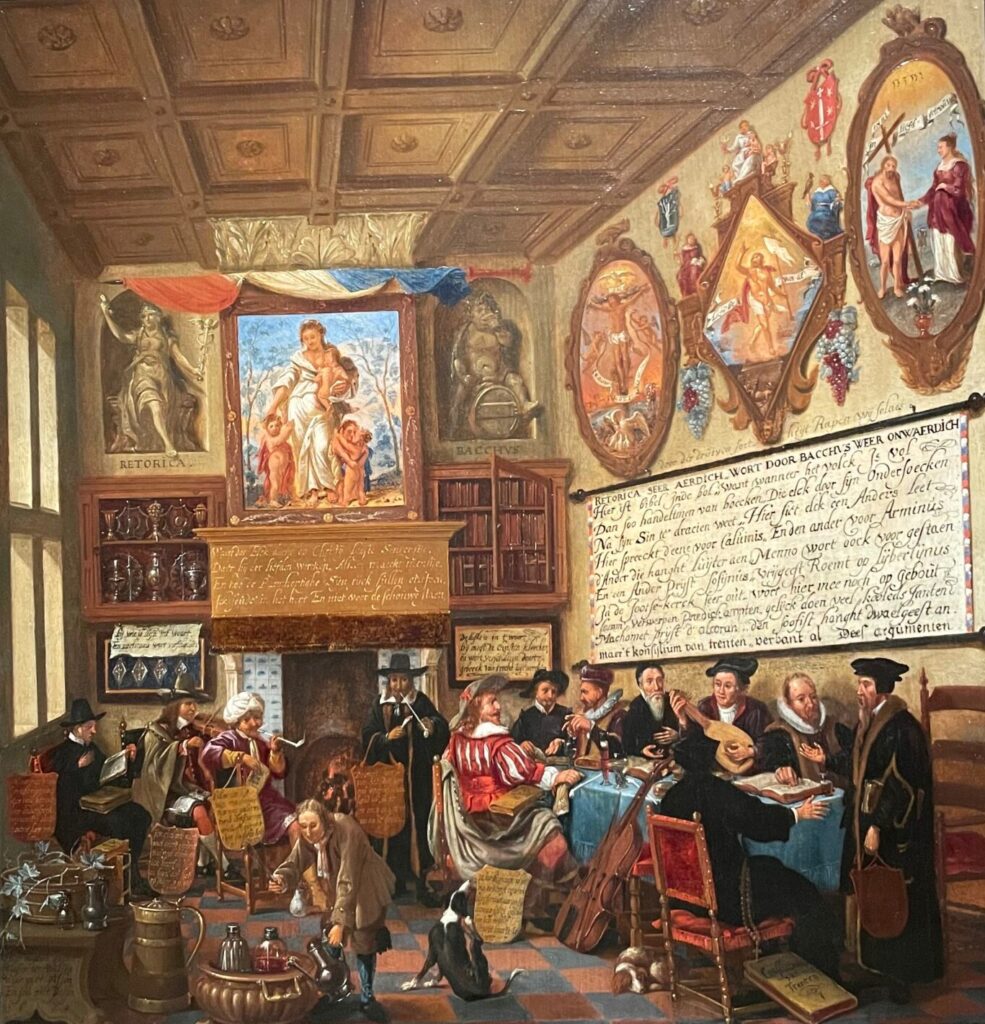
Interior of a Chamber of Rhetoric with Presentation Silver in the Background (Photo: Frans Hals Museum, inv. no. OS I-552).
Within the culture of the chambers of rhetoric, religion played an important role. Celebrations and traditions had an explicitly liturgical character, and the literature they produced was devotional in nature. Their strong ecclesiastical foundation is also evident from the fact that many chambers of rhetoric were named after a patron saint or another divine symbol, such as the Bruges Holy Spirit. The Holy Trinity proved to be a symbol of great expressive power, clearly reflecting the cultural ideal of this particular chamber of rhetoric. As the literal messenger between the heavenly and the earthly realms, the Holy Spirit proclaimed the word of God on earth. In a similar
way, the chamber bearing the same name sought to enlighten its members and the inhabitants of Bruges through the literature it produced. This ideal is further emphasized by the motto “Mijn werk is hemelijk” (“My work is heavenly”), which is also engraved on the silver-gilt cup. Because of their prominent position in popular public life in the Low Countries, the chambers of rhetoric had a significant influence
on the development of devotional practice.
Not only literary culture flourished in 16th and 17th century Bruges, the city was also an important centre of gold- and silversmithing. The high level of craftsmanship stemmed from the prosperous Burgundian period, when goldsmiths and silversmiths enjoyed princely patronage.
Even in the 17th century, Bruges remained one of Europe’s leading production centres for precious metalwork. Bruges silver was a worthy counterpart to the highly acclaimed gold- and silversmithing of Augsburg and Nuremberg. Stylistically, Bruges silver is characterized by a somewhat conservative taste—much like Bruges painting. The formal language of the Renaissance was retained for a long time. In the present cup, many elements still recall the 16th century, such as the medallions, the cast freestanding volutes, the baluster-shaped stem, and the form of the bowl. The refined repoussé work is also characteristic. Bruges silversmiths had become specialists in the repoussé technique over the years. The cup closely resembles similar gilt goblets that were frequently depicted in contemporary still-life paintings.
What makes this cup particularly interesting is its connection to the Bruges chamber of rhetoric De Heilige Geest. The striking dove atop the lid directly refers to the third person of the Holy Trinity, the Holy Spirit. The inscription of the motto “Myn werk is hemelick” further confirms that this gilt goblet belonged to the prominent Bruges chamber.
Moreover, the cup remained for a long time in the possession of the family of Ignace-Joseph Pardo de Frémicourt (1720–1792), who in the 18th century was the last Headman of De Heilige Geest. It is known that chambers of rhetoric often possessed ceremonial silver display pieces, presumably as trophies or commemorative objects from won competitions.
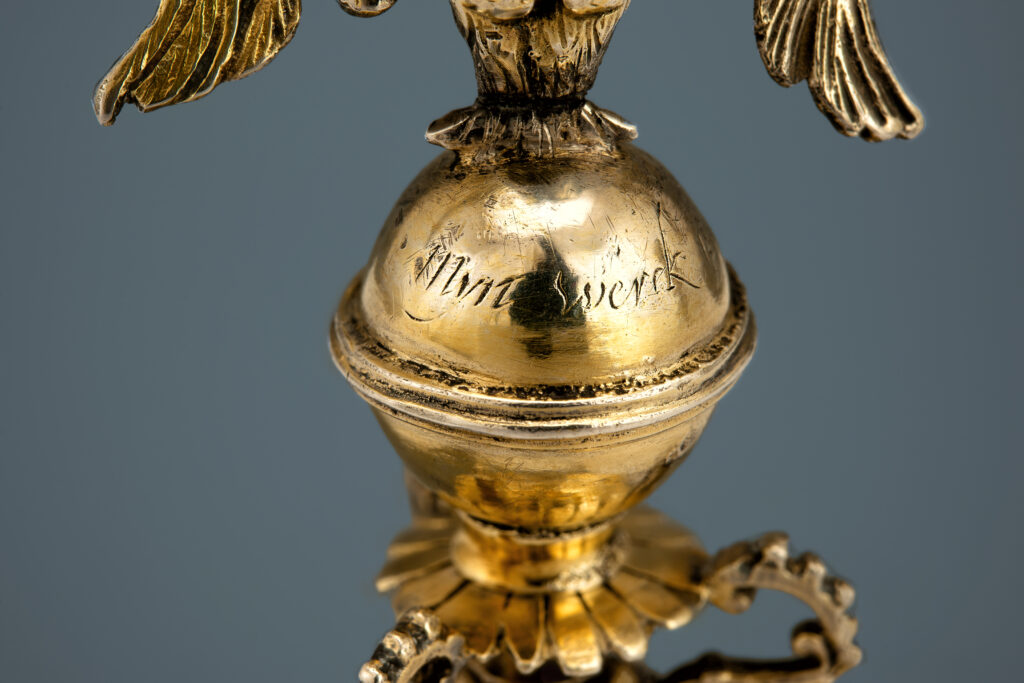

The second inscription, “Desen Cop is ghemaeckt van prysen ghewonnen by die van dese ghilde 1661,” also refers to the chamber. It indicates that the cup was made from prizes won by the members of De Heilige Geest. Notably, the date 1661 differs from the production date indicated by the date letter (1610–11). It is possible that De Heilige Geest won a rhetoricians’ competition in 1610–11 and that the cup served as a victory trophy, or that at that time the Bruges silversmith Loys van Nieukercke II was commissioned to create the cup from prize money as a commemorative object. In that case, the inscription may have been added later, in 1661. A festive occasion for adding the inscription may have been the inauguration of a new Hoofdman in 1661, a lifelong position that year held by the then Mayor of Bruges, Hendrik Anchemant II (1611–1669). It is conceivable that from that time onward the cup was passed from headman to headman and eventually entered the family of the last headman in 1792, when the chamber was dissolved. Although there is room for interpretation regarding the precise meaning of the inscription, it is clear that the cup was an important object for De Heilige Geest. Silver was expensive, conveyed status, and in 17th century Bruges it was also a prestigious export product. The fact that the commission was given to the prominent local family workshop of Loys van Nieukercke II reflects a sense of civic pride within De Heilige Geest. It is therefore unsurprising that the membership included several individuals who were part of Bruges’ civic government. The presentation cup embodies not only the high point of Bruges silversmithing but also the creative and literary culture of early modern urban society in the Low Countries.
Provenance
Rhetoric Chamber "De Heilige Geest" 1610-1611;
After its dissolvement in the collection of Ignace-Joseph Pardo de Frémicourt (1720–1792):
By descent in the same family until 2025
Associated Literature
Stedelijk Museum Brugge, Edelsmeedkunst in het Brugse, Brussel, 1950; Stedelijk Museum Gruuthuse Brugge, Zilver & Wandtapijten, Brugge, 1980;
D. Geimaert, “De kamers van rhetorica te Brugge. Een blik op 400 jaar Brugse rederijkersactiviteit,” in: Biekorf 95, nr. 3 (1995), 234-250;
A.L. Van Bruane, Om beters wille - Rederijkerskamers en de stedelijke cultuur in de Zuidelijke Nederlanden (1400-1650), Amsterdam, 2008;
W. van Dievoet, Brugse edelsmeden van het ancien régime, Brussel, 2014
Loys van Nieukercke II, Bruges, 1610-1611
Dimensions
Height 39,3 cm.

A silver windmill cup typical outline, the matted cuppa containing three ovals, two with engraved armorials and the other…

The hexagonal body surmounted by a vaulted cover on a protruding edge, the centre of the lid engraved…

Of oblong section, the hinged covers with silver overlay on a gold ground pierced with monkeys, vases with…