Pablo Picasso (1881–1973), Compotier Trefle
Pablo Picasso (1881–1973)
Compotier Trèfle
Designed April 1958 and executed in an edition of 11
This edition is number one of the last five, executed between may 1977 and october 1979 by François Hugo (1899-1982).
Pablo Picasso may well be considered the world’s most famous artist. For much of the 20th century, Picasso shaped the Western art canon, constantly experimenting with new styles and pushing innovation across a wide range of media. Few artists have been as influential or have inspired as many followers. Most people are familiar with Picasso’s paintings, his collage work, his sculptures in a wide variety of materials, and his decorative, widely celebrated ceramics. Less well known – likely because the artist kept them strictly to himself for many years – is the series of silver sculptures that Picasso created.
Picasso’s unique series of four compotiers
In the mid-1950s, inspired by Renaissance gold and silver dishes from France, Augsburg, and Venice, Picasso began to explore the medium of silver. He soon became reacquainted with the silversmith François Hugo, an old friend from the Parisian avant-garde scene whom he had known since 1917 – and, coincidentally, a great-grandson of the writer Victor Hugo. François Hugo’s career as a metalsmith had not yet fully taken off, so the extra income and visibility this commission promised were more than welcome. Out of this grew a truly unique collaboration.
One of Picasso’s most important conditions was that his silver works should not be cast, but made by hand using the more sculptural repoussé technique. At first, Picasso provided ceramic plates of his own design, from which Hugo made negative moulds in which he then embossed the silver sheets. This resulted in direct silver replicas of Picasso’s existing ceramics. The duo experimented extensively to arrive at a suitable procedure, while Picasso supervised the process closely to ensure that Hugo’s silver table pieces had exactly the desired thickness and texture, and were perfectly identical to one another.
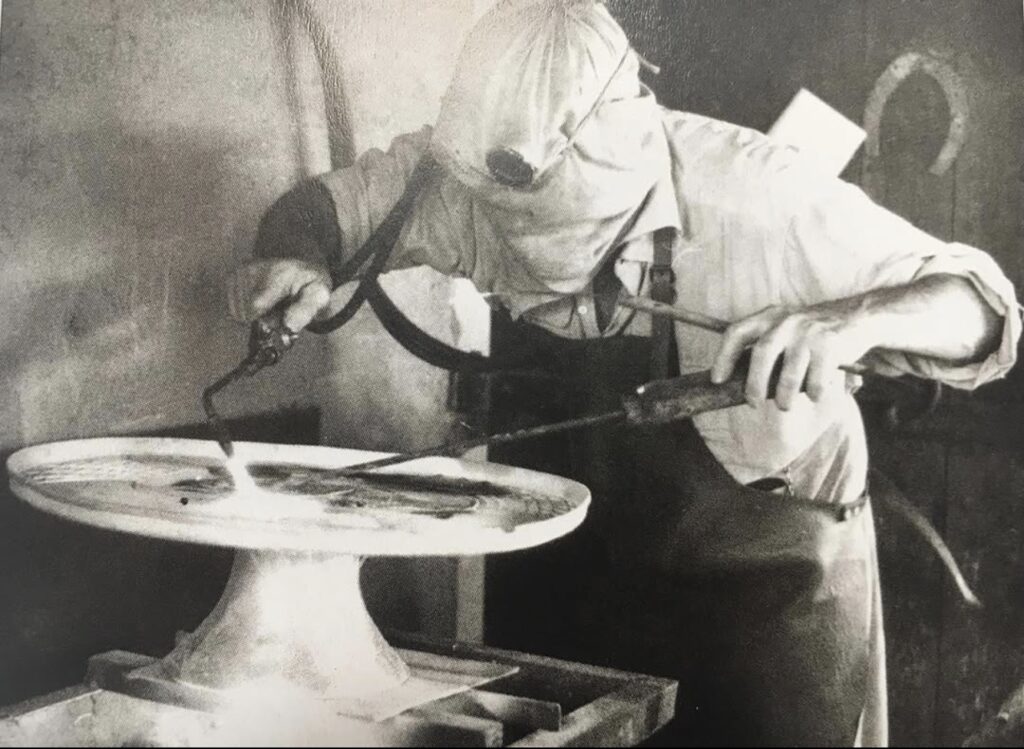
François Hugo in his studio working on the Compotier Rond, after a design by Picasso (Photo: screenshot from Insta Ateliers Hugo).
Later, after Picasso had gained full confidence in Hugo’s abilities, he wished to take a step further and create more complex forms without relying on ceramic models. In April 1958, Picasso produced design drawings for four compotiers – including the Compotier Trèfle – which Hugo had to translate as precisely as possible into silver objects. The likeness between the drawings and the finished compotier demonstrates how faithfully Hugo followed Picasso’s design. He likely traced the drawing and constructed the repoussé mould directly from it. As a result, the measurements were transferred and the finished compotier is a mirrored image of the drawing.
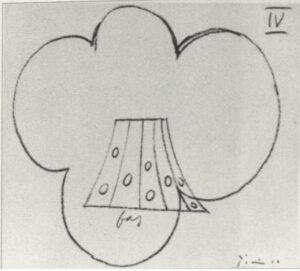
Picasso’s design drawings for the Compotier Trèfle (Photo: Sotheby’s, New York).
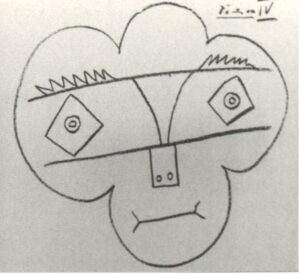
Picasso’s design drawings for the Compotier Trèfle (Photo: Sotheby’s, New York).
Working in silver meant more to Picasso than simply exploring a new material. The tension between the precious, noble metal on the one hand and the playful, comically rendered figures on the other served as a witty nod to the artist’s own life: despite his worldwide fame and his grand villa on the Côte d’Azur, Picasso still felt, at heart, the same creative soul he had always been. He also wanted his silver table pieces to champion the applied arts, which had long been undervalued. Throughout his career he fought to elevate their status. Moreover, in this series of silverware Picasso sought to test the boundary between two- and three-dimensional art. Although the upper sections of the compotiers usually draw the most attention, they can also be seen as busts, with the foot functioning as a neck.
Private treasures in small editions
By 1967, Hugo had firmly established his reputation as a master goldsmith through a series of successful collaborations with artists such as Hans Arp, Max Ernst, and Jean Dubuffet. That year he was accorded a major retrospective exhibition in Paris, and on that occasion Picasso granted him permission to produce a small commercial edition of the compotiers, limited to three examples. For the first time, these works emerged from Picasso’s private sphere and became accessible to a wider public. From 1977 onwards, in response to their growing popularity, Hugo’s workshop issued an additional edition of all four compotiers, this time limited to five examples. The present Compotier Trèfle belongs to this later edition. Notably, Picasso and Hugo had already conceived the idea to produce twenty small gold medallions based on the silver table pieces in 1972.
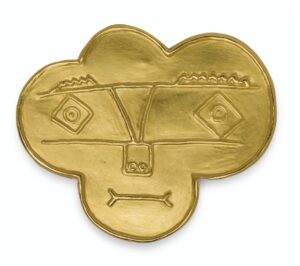
Fig. 3: Medallion after the Compotier trèfle (Photo: Christie’s, New York, 2016).
The Compotier trèfle within Picasso’s oeuvre
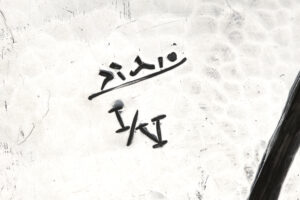
The present work, the fourth and most idiosyncratic of Picasso’s series of four compotiers, is the so-called Compotier trèfle, although that name is actually misleading, since it is not a clover with three but with four leaves. This example is the first of the five that were made after 1977, when Picasso’s youngest son, Claude, gave permission for the release of a new limited edition of compotiers in an edition of five. The pieces from this edition were numbered with Roman numerals. That the present Compotier trèfle is of slightly later manufacture can be seen, in addition to the numbering, from the base. In 1958 Hugo still outsourced the making of the base to a specialized workshop, which decorated the foot according to the instructions on Picasso’s design drawing. The smooth bases of the later editions, by contrast, were made by Hugo himself and are therefore stamped with his workshop mark. Moreover, the folded rim of the upper plate is characteristic of Hugo’s atelier. This is a technique he frequently employed as a dinanderie craftsman and one that is in fact unusual for silver.
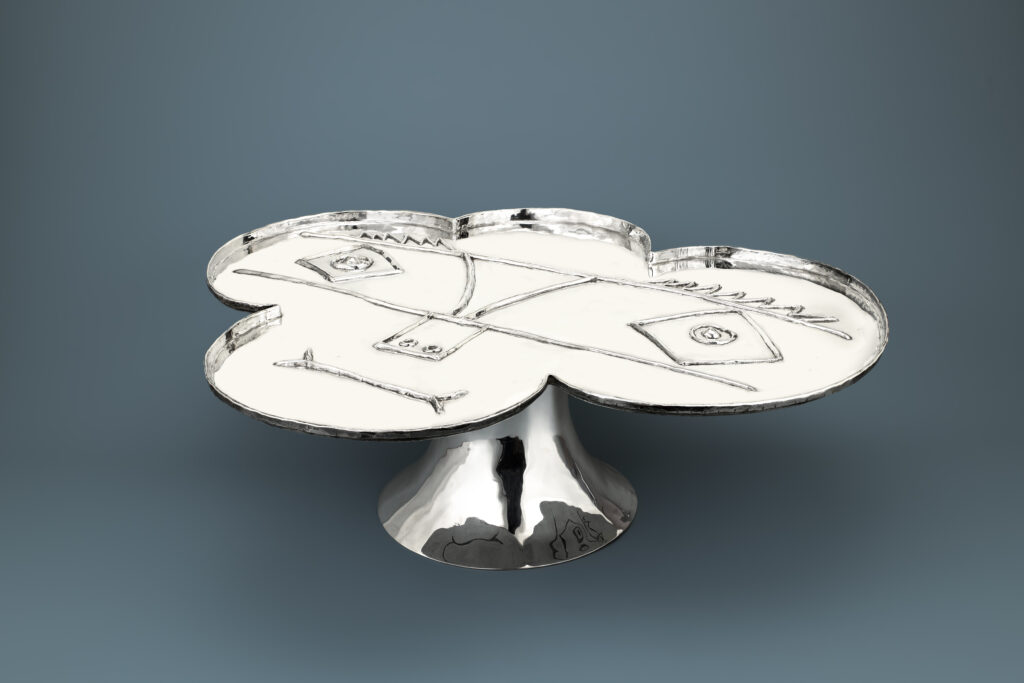
The pursuit of such experimental, unconventional procedures was of particular value to Picasso, who constantly sought to push artistic boundaries. The striking, clover-leaf-like face of the Compotier trèfle is characteristic of Picasso’s late portraits, in which a similarly radiating facial structure appears repeatedly. As the artist grew older, he became increasingly fascinated by the different stages of life, personality types and social classes of humankind. This theme of the comédie humaine is beautifully expressed in Picasso’s silver oeuvre. His silver plates and compotiers each depict faces with their own distinctive characteristics. Taken together, they form a colourful panorama of different human types within society. The Compotier trèfle, by recalling the features of Picasso’s late self-portraits, appears to engage with the theme of ageing. Once the silver has been polished to a high sheen, the viewer sees their own reflection, raising the question of how one relates to the character created by Picasso on one’s own place within the comédie humaine.
In this way the present Compotier trèfle is exemplary of Picasso’s late work, in which his drive for innovation remained fully intact. This is evident not only in his exploration of a new medium and new techniques, but also in his streching of the boundaries between applied and autonomous art and between two- and three-dimensionality. At the same time, the work connects closely with Picasso’s late thematic preoccupations with psychological character and the course of human life.
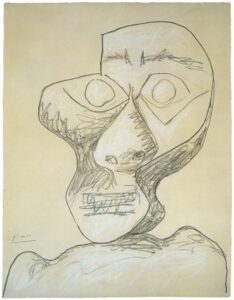
Fig. 4: Pablo Picasso, Self portrait, 1972 (Photo: Estate of Pablo Picasso/Artists Rights Society (ARS)).
Provenance
In 1977, the renowned Amsterdam art dealership E.J. van Wisselingh & Co., in collaboration with François Hugo’s workshop, organised a unique selling exhibition featuring all nineteen silver plates that Picasso and Hugo had created after Picasso’s existing ceramic designs. It was, since the 1967 exhibition mentioned before, one of the very first occasions on which Picasso’s silverwork was shown publicly, and the exhibition was a great success. Through this exhibition the gallery owner became acquainted with a number of admirers and collectors of Picasso’s work and was on good terms with François Hugo, as old correspondence shows.
Through this connection, in October 1979, the Amsterdam based Wisselingh gallery was able to acquire the first example of each of the four compotiers from the edition approved by Picasso’s son, directly from the Atelier Hugo. Presumably the gallery owner himself was very attached to these special silver table pieces, because he did not offer the Compotier trèfle together with the Compotier Poisson to a Dutch collector until 1986. The Compotier trèfle remained in the family of this Picasso enthusiast for many years, until it recently reappeared on the market.
Provenance
Francois and Pierre Hugo, 1979 sold to;
E.J. van Wisselingh & Co.; 1986
Private noble Collection, The Netherlands until 2025
Associated Literature
D. Cooper, Two master-craftsmen, Francois and Pierre Hugo at the service of Picasso, 1977 (Catalogue Wisselingh-exhibition);
W. Spies, Picasso: The Sculptures, Stuttgart, 2000, p. 383, no. 551 (another example illustrated);
C. Siaud and P. Hugo, Bijoux d'artistes, Hommage à François Hugo, Aix-en-Provence, 2001 (another example illustrated, p. 161);
C. Finn, ‘The Decorative Metalwork of Pablo Picasso: His Collaboration with François Hugo’ (PhD diss.), Royal College of Art, 2004;
C. Finn, ‘Art on a Plate, Picasso’s Silver Compotiers’, Apollo, May 2007, vol. CLXVI, No. 543, pp. 72 – 76;
C. Finn, ‘Auteur and Artiste, Differences of Opinion: Picasso’s Collaboration with François Hugo,’ during the Internacional Seminar Picasso and Applied Arts, Málaga, Museo Picasso, 17 & 18 November 2022. https://www.youtube.com/watch?v=isazyXMPvV8.