A gold Gothic Revival pomander
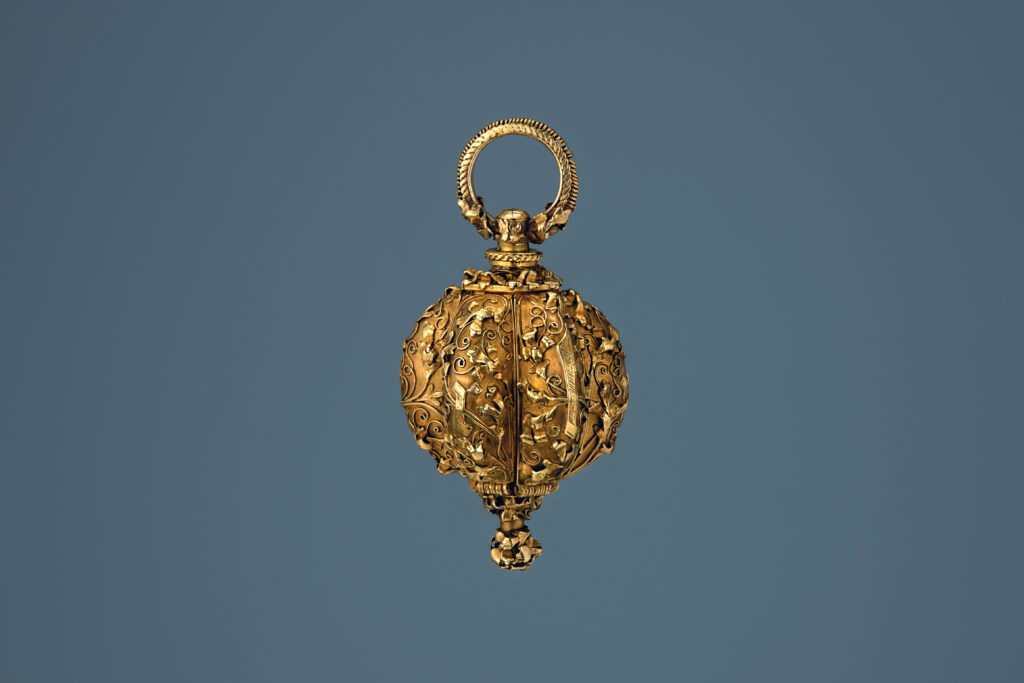
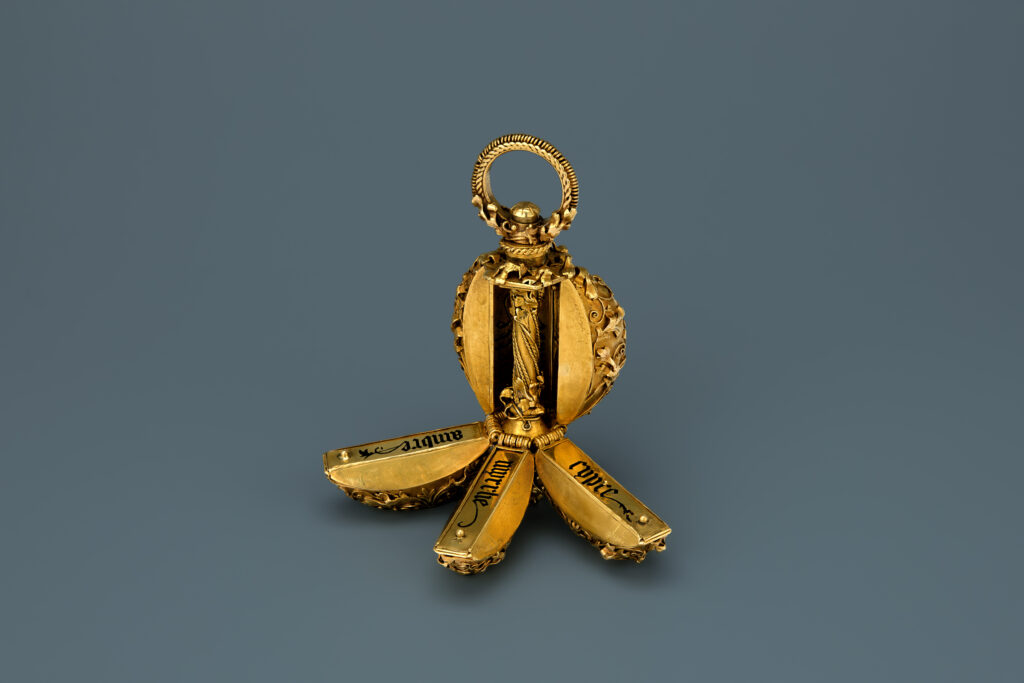
A gold pomander in the form of a pomegranate, consisting of six hinged falling scent and herb containers, each panelled section with a sliding cover and respectively engraved with CIVET, MUSC, CYPRE, MYRRTE, AMBRE en BENIOM, and decorated with vine and scrolling thread surrounding a letter, when closed forming the word VIRTUS (virtue), the central stem is decorated with rope decoration and when closed centered by a suspension ring, decorated with further vines.
The present pomander in neo-gothic style and manufactured in Paris around 1840, perfectly fits within the Gothic-Revival. This style had become extremely popular in France during the years 1830-1850 and was partly fuelled by the interest in medieval heritage, especially after the publication of Victor Hugo’s Notre dame de Paris. Pomanders such as this, were often executed in silver, silver-gilt or even, as is the case here, in gold.
From the Renaissance through the 18th century, France was obsessed with adopting and developing classical architectural forms while disdaining the magnificent Gothic monuments which had once been her glory. The Revolution of 1789 brought the de-sanctification, decay, and often the destruction of cathedrals and churches. A renewed interest in the medieval era and in gothic monuments was stirred by literary trends in the early-19th century, especially the writings of Sir Walter Scott and René de Chateaubriand. After the July Revolution of 1830, France was in need of a sense of heritage that surpassed regime and ruler.
Victor Hugo published his novel Notre-Dame de Paris only seven months after the July Revolution. His passionate and vivid descriptions of Notre-Dame Cathedral and of the Gothic method and style of construction identified Gothic monuments as the work of the entire French people and as the native architecture of France. His eloquent conviction provided France with a longed-for patrimony. The novel, instantly and tremendously popular, inspired illustrations by artists of all media. Salon painters, lithographers, book illustrators, caricaturists, and, later, photographers all sought to illustrate scenes from the novel or to depict the cathedral itself. Even silver- and goldsmiths started to work in the neo-gothic taste. Parisian workshops started to manufacture many decorative objects, a.o. jewellery, vinaigrettes and other items, with references to gothic arches, pinnacles and fine latticework. Just as their medieval predecessors, these 19th-century objects intended to store fragrant substances (musk, amber), but they mainly served as a fashionable, romantic accessory. Often such objects were embellished with enamel or fine chiselling work, fitting with the romantic fascination for the Middle Ages.

About the engraved panels:
CIVET: Civet is one of the oldest animalic notes in the world of perfumery. In its natural state, it is extremely strong and fecal; however, when highly diluted, it imparts a sensual, warm, and “skin-like” depth to fragrances.
MUSC: Musk is an intense and sensual fragrance ingredient, originally derived from the male musk deer. It is frequently used as a base note to add depth and warmth to fragrance compositions.
CYPRÈS: Cypress essential oil provides a fresh, dry, aromatic, and woody note. It is frequently used in masculine fragrances or fougère compositions.
MYRTE: Myrtle has a fresh, spicy, aromatic, and subtly floral scent profile. It is often incorporated into the top or heart notes to lend an aromatic character.
AMBRE: Ambergris is a rare, waxy substance produced in the intestines of sperm whales, often referred to as “floating gold” due to its high value in the perfume industry. It serves as an exclusive fixative that helps fragrances last longer and enhances their longevity.
BENIOM: This most likely refers to the balsamic resin benzoin (often Siam benzoin). It is used as a base note to provide a warm, vanilla-like, sweet, and balsamic aroma, and is frequently paired with amber.
Provenance
Private collection, The Netherlands