A miniature cabinet of curiosities
From a small oak cabinet datable to around 1700 a group of various objects looks at us. The…
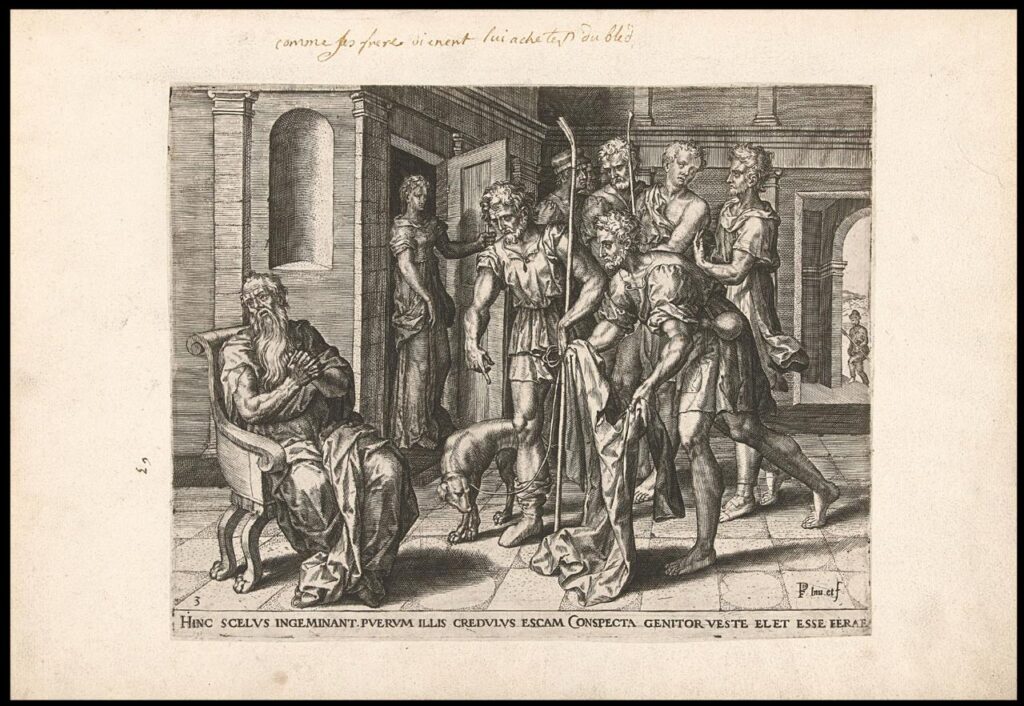
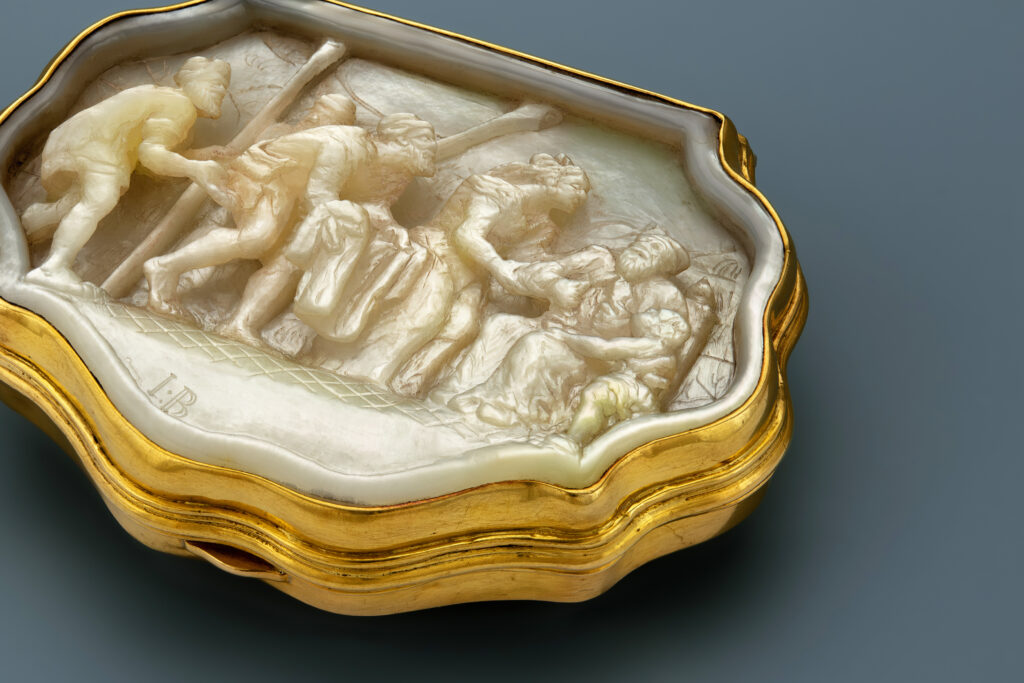
The box of scallop section and mounted to one side with a mother-of-pearl plaque carved in high relief and representing a biblical scene, taken from the life of Jacob (Gen. 37:31-35). Jacob is seated on the right, and is flanked by his youngest son Benjamin, to Jacob’s left stands Rachel, on the left Joseph’s half-brothers, holding shepherd’s crooks, while returning home, to show Jacob his son’s torn and bloodstained cloak.
Joseph, who was the son of Jacob and his beloved wife Rachel, lived in the land of Canaan with ten half-brothers (sons of a.o. Leah), one full brother (Benjamin), and at least one half-sister (Dina). Joseph was Rachel’s firstborn and Jacob’s 11th son. Of all the sons, Joseph was preferred by his father, who gave him a ‘long coat of many colours’. When Joseph was 17 years old, he shared with his brothers two dreams he had: in the first dream, Joseph and his brothers gathered bundles of grain, of which those his brothers gathered, bowed to his own. In the second dream, the sun (father), the moon (mother), and 11 stars (brothers) bowed to Joseph himself. These dreams, implying Joseph’s supremacy, angered his brothers (Genesis 37:1-11) and made the brothers plot his demise.
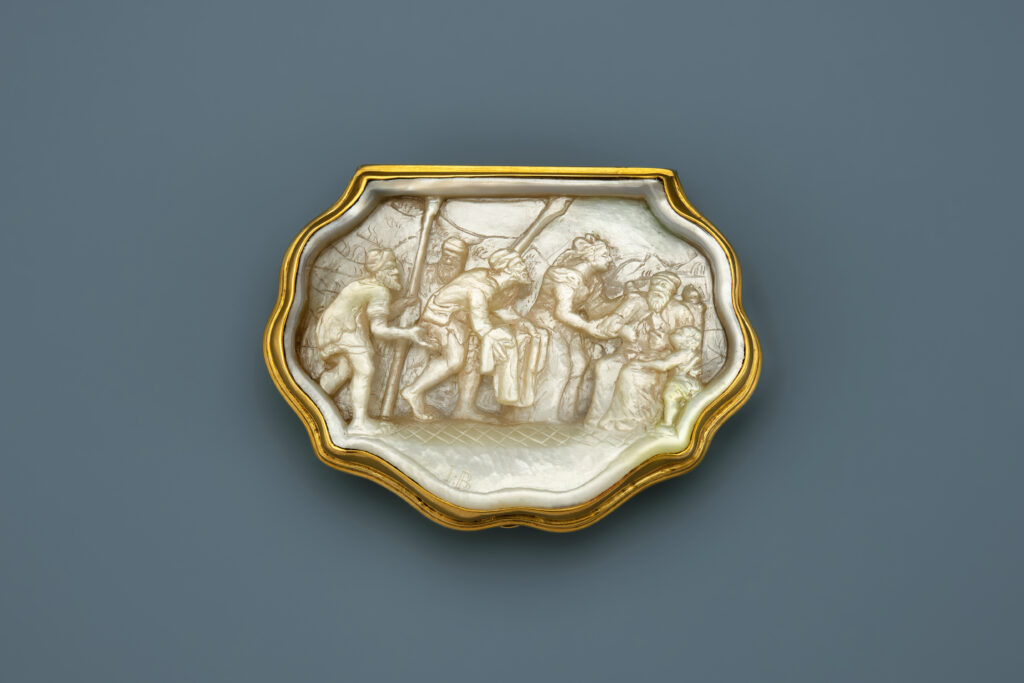
In Genesis 37, Joseph’s half-brothers were envious of him. Most of them plotted to kill him in Dothan, except Reuben, who suggested they throw Joseph into an empty cistern; he intended to rescue Joseph himself later. Unaware of this plan to rescue Joseph, the others agreed with Reuben. Upon imprisoning Joseph, the brothers saw a camel caravan carrying spices and perfumes to Egypt, and sold Joseph to these merchants. The guilty brothers painted goat’s blood on Joseph’s coat and showed it to Jacob, who therefore believed Joseph had died.
Gen.37:31-35:
31 Then they got Joseph’s robe, slaughtered a goat and dipped the robe in the blood. 32 They took the ornate robe back to their father and said, ‘We found this. Examine it to see whether it is your son’s robe.’
33 He recognised it and said, ‘It is my son’s robe! Some ferocious animal has devoured him. Joseph has surely been torn to pieces.’
34 Then Jacob tore his clothes, put on sackcloth and mourned for his son many days. 35 All his sons and daughters came to comfort him, but he refused to be comforted. ‘No’, he said, ‘I will continue to mourn until I join my son in the grave.’ So his father wept for him.
Silversmith Cornelis de Haan was born in The Hague in 1735. He became a master goldsmith there in 1755 and married Anna Dorothea van Bohemen three years later. He was head of the Hague guild of goldsmith’s between 1767 and 1771, and died in 1788.
Jan Bernard Barckhuysen (1684-1760), an iron-cutter at the Gelders Mint in Harderwijk by profession, left an impressive oeuvre in mother-of-pearl and is now considered to have been one of the most important workers in 18th-century Holland in this field. Some examples of his art can be found in museums throughout Europe. For instance in the Rijksmuseum, Amsterdam, where an octagonal box, made by Peter Schemkes, 1750, with mother-of-pearl-cover, signed I.B. Barckhuysen fecit, was added to the collection. In the Victoria and Albert Museum in London an engraving in mother-of-pearl of his hand can be found, presenting Esther and Ahasverus, a biblical scene. Not only biblical subjects, but also mythological subjects are present in Barckhuysen’s oeuvre. In private collections silver objects, inset with mother-of-pearl engravings of this master, exist, presenting a great variety of gods and goddesses of the ancient Romans and Greeks. Dr Wouter H. van Seters in his article Parelmoerkunstenaars in de 18de eeuw, in Nederlands Kunsthistorisch Jaarboek, vol. 17, 1966, mentions mythological scenes of Sleeping Venus in a landscape, Phaeton, Vulcan, Cupid, Paris and many others, which indicates that Barckhuysen must have had an extensive knowledge of mythological, allegorical and biblical subjects.
Provenance
Private collection, The Netherlands
Associated Literature
Dr Wouter H. van Seters, Parelmoerkunstenaars in de 18de eeuw, het werk van J.B. Barckhuysen, J.C. Konsé en C. la Motte, in Nederlands Kunsthistorisch Jaarboek, vol. 17, 1966, p. 247-263
Cornelis de Haan (1735 The Hague 1788), The Hague, 1753
The carved mother-of-pearl plaquette I.B. for Jan Bernard Barckhuysen (1684 ? - Harderwijk1760)

From a small oak cabinet datable to around 1700 a group of various objects looks at us. The…

This eight-component silver toilet service consists of a casket for combs, two smaller boxes for facial- or hair…

A silver teapot of plain octagonal pear form with molded borders, conforming swan-neck spout and with hinged flap,…