A Knottedoosje or marriage box
The hexagonal body surmounted by a vaulted cover on a protruding edge, the centre of the lid engraved…
A silver windmill cup typical outline, the matted cuppa containing three ovals, two with engraved armorials and the other displaying a drinking scene, between plain borders, the upper part with three persons on the steps, one carrying a bag.
The respective arms are those of Sixma (two acorns above a single oak leaf in a shield topped by a crest consisting of a crown with three ostrich feathers) and Haubois (a shield containing two stars and a crescent moon above three scallops surmounted by a crown with unicorn), more precisely Douwe Douwes van Sixma (*1634 – †1684), who married Romck Cornelisdr Haubois (*1635 – †1687), in 1665. The third reserve is engraved with a pastoral scene of a drinking company.


Amongst the Dutch silver wager cups which were produced from the late 16th century until the early 18th century, the so-called windmill cups were the most popular. The feet of these cups are in the form of the upper part of a windmill and therefore they cannot be put down until they have been drained. The cup itself, usually divided into horizontal bands, might be decorated with engraved strapwork, flowers, drinking-songs, names or monograms.
Before drinking the cup one had to blow through the blowpipe on the backside, by which the sails were set in motion. At the same time a hand was set in motion indicating a figure from one to twelve. The hand indicated the number of beakers the drinker had to finish if he did not empty the cup before the sails stopped. The oldest extant Dutch windmill cup was made in Leeuwarden by Cornelis Floris around 1580.

The windmill cup was on display at the exhibition Friesch Zilver in the Fries Museum, Leeuwarden, in the summer of 1927. There was one showcase present with two shelves for objects of the Royal Family. The factual contribution of the family was not mentioned in the exhibition catalogue, however a very rare photograph of the showcase was stuck in Nanne Ottema’s personal catalogue with his own annotations, which is now in a private collection.


Provenance
Collection Douwe Douwes Sixma and his wife Romck Cornelisdr Haubois, by descent to their son
Collection Douwe Tjallings Sixma (*1680 – †1714), by descent to his son
Collection Tjalling Edo Hessel Sixma (*1707 Lungo – † The Hague 1775)
Collection H.M. Queen Emma Princess of Waldeck Pyrmont (*1858 Arolsen –The Hague †1934), who was the second wife of King Willem III of the Netherlands, thence by descent to
Her daughter, H.M. Queen Wilhelmina of the Netherlands (*1880 The Hague - Loo Palace, Apeldoorn †1962) thence by descent to her daughter
Collection H.M. Queen Juliana of the Netherlands, (*1909 The Hague – Soestdijk Palace, Baarn †2004)
Private collection, UK
Literature
Nanna Ottema e.a., Tentoonstelling van Friesch Zilver, Leeuwarden, 1927, the objects of the royal family introduced
Associated Literature
Wim Nys, Zilveren wind- & watermolenbekers in Europa, 1530-1760, MOU in Oudenaarde, Zwijndrecht, 2012, for other examples
Exhibitions
Tentoonstelling van Friesch Zilver, Fries Museum, Leeuwarden, 15/08-15/09/1927
Wieger Jansen van Isens, Sneek, 1666
Dimensions
Height 22,2 cm.
Weight
242 grs.

The hexagonal body surmounted by a vaulted cover on a protruding edge, the centre of the lid engraved…
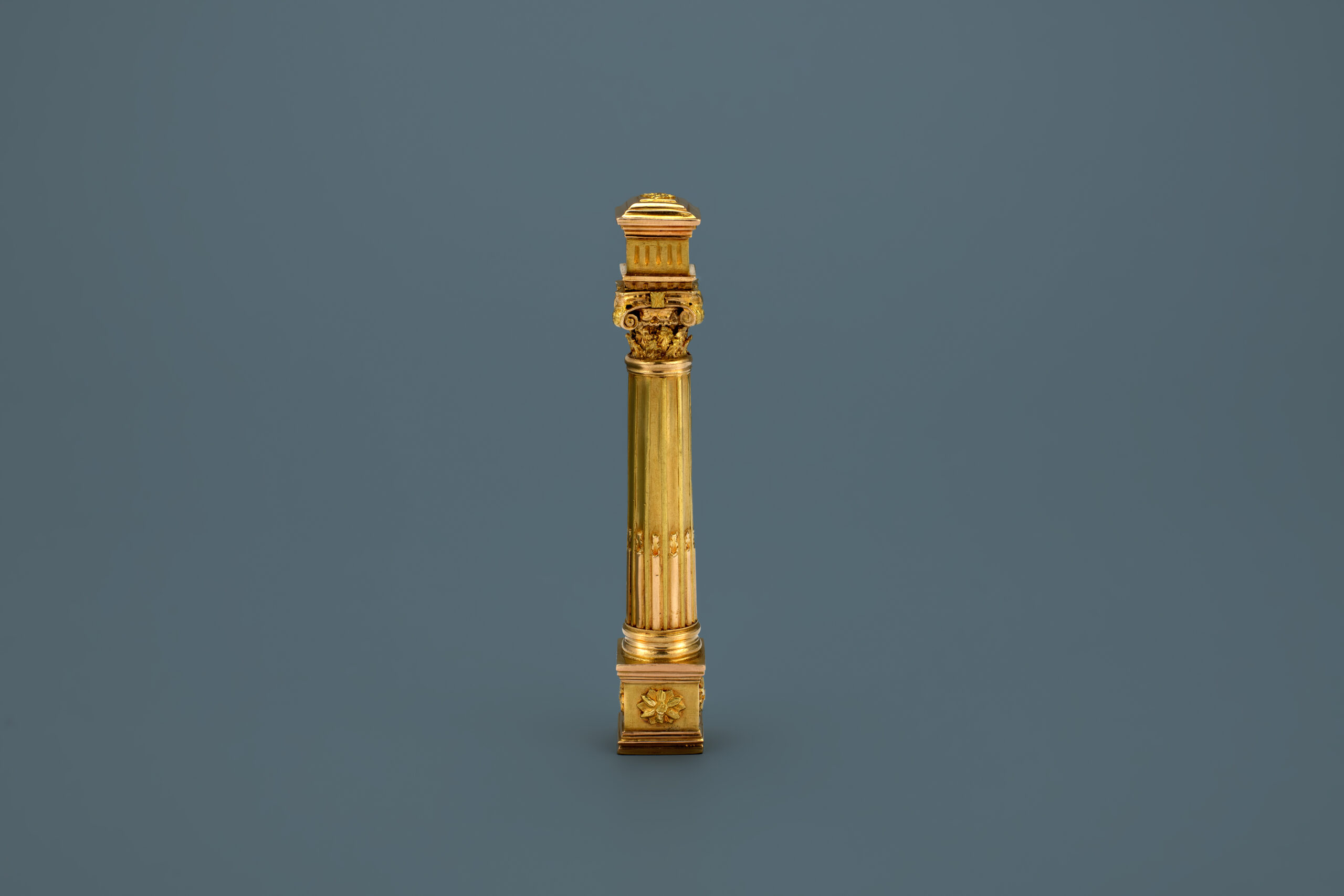
Shaped as a Corinthian column, the square plinth on reeded stepped base, on each side applied with a…

A gold pomander in the form of a pomegranate, consisting of six hinged falling scent and herb containers,…