A silver wedding windmill cup
A silver windmill cup typical outline, the matted cuppa containing three ovals, two with engraved armorials and the other…
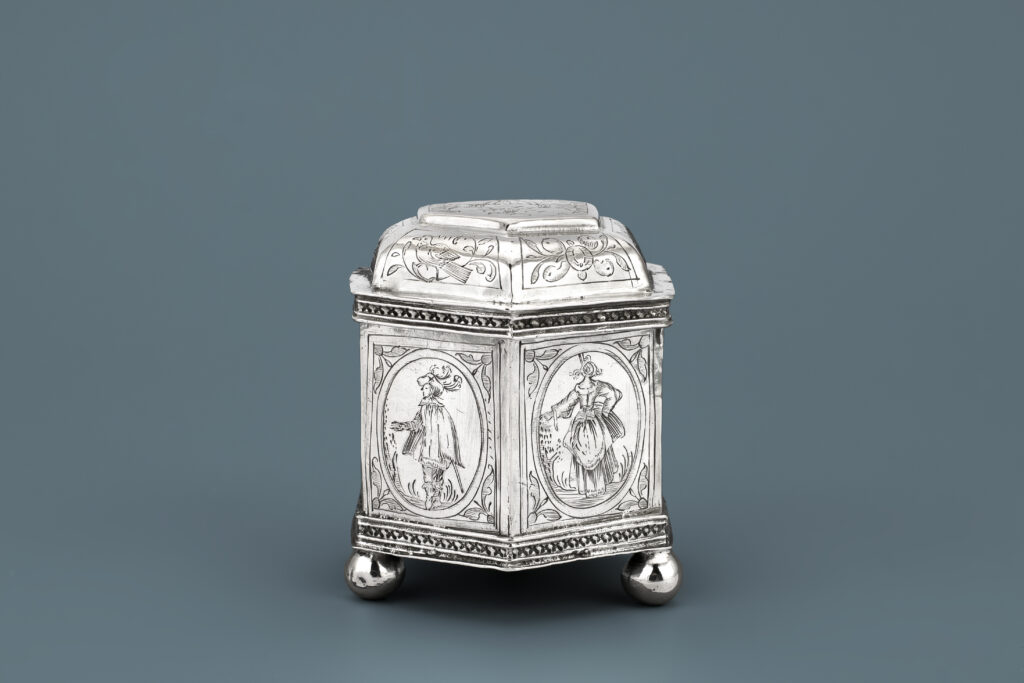
The hexagonal body surmounted by a vaulted cover on a protruding edge, the centre of the lid engraved with two hands together against a flaming heart, below a pigeon in flight, probably representing the Holy Ghost, surrounded by six panels, each alternately engraved with fruits and birds, the body with six smooth sides walls each engraved with an oval medallion, containing a single figure against a landscape background, men and women alternated, the angles with foliate spandrels, the whole mounted in an applied upper and lower reeded and dots band and raised on three globular feet.

The marriage casket, in Dutch knottekistje, belonged to the engagement ritual. In the 16th century it was customary that a young man offered the girl of his dreams a coin, when he asked her to marry him. When she would accept the token, she could consider herself engaged to be married. When offered several coins, they were offered assembled in a cloth with a special knot: a so-called knotte (or knottedoek). This ‘knot’ was loosely tied. When the girl would pull the knot, then her answer was positive and the young couple would be engaged. With the improvement of the level of prosperity the cloth was replaced by a silver casket, the so-called knottekistje. This small token and its contents remained the property of the girl and supposedly was regarded as saving for a rainy day.
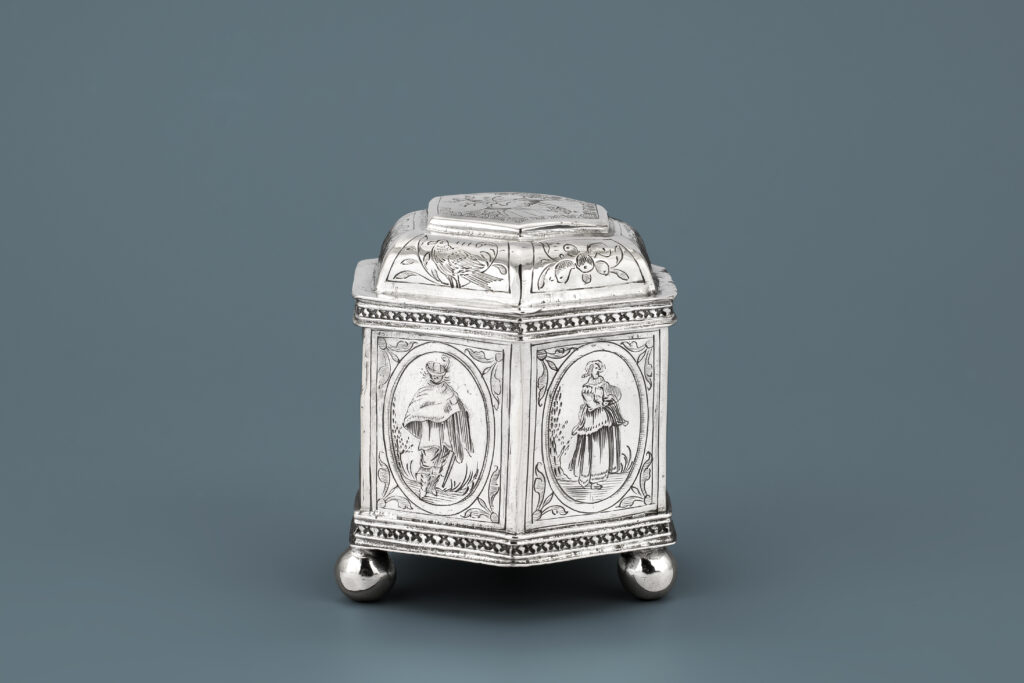
Most of the marriage caskets are datable to the 17th or early-18th centuries and were mainly manufactured in Friesland and North-Holland. In some cases a special gold marriage medal was made that was offered in the casket.
The engravings on the present casket resemble those on a comparable box, collection Rijksmuseum, Amsterdam, inv. n° BK-NM-10926 (See Ter Molen, vol. III, p. 867, ill. P. 866), i.e. single figures in landscapes, alternating a man and a woman.
Provenance
E.H. Crone, 1916;
Thence by descent until 2025
Associated Literature
Catalogue Tentoonstelling van Friesch Zilver, Fries Museum, Leeuwarden, 15/08-15/09/1927, p. 54-55, Trouwkistjes;
Elias Voet Jnr, Merken van Friesche Goud- en zilversmeden, Martinus Nijkhoff, The Hague, 1974, n° 381, the mark of the silversmith;
Cornelis Boschma, Friese en Noordhollandse Knottekistjes, in Antiek n° 3, 1969, p. 559-566;
Prof. Dr Johan R. ter Molen, Fries Goud en Zilver, Bornmeer, Gorredijk 2014, vol. III, n° 326, p. 867, ill. p. 866, a similarly engraved hexagonal box, collection Rijksmuseum, Amsterdam, inv. n° BK-NM-10926
Frans Cornelis Roos, (active in Leeuwarden, circa 1603-1634)
Dimensions
6,5 cm high, 6 cm wide

A silver windmill cup typical outline, the matted cuppa containing three ovals, two with engraved armorials and the other…
Shaped as a Corinthian column, the square plinth on reeded stepped base, on each side applied with a…

A gold pomander in the form of a pomegranate, consisting of six hinged falling scent and herb containers,…