A jewellery casket
This jewellery casket is decorated with mother-of-pearl plaquettes and cabochons. The ebony is embellished with engraving in gold….
The canister, of canopic form, stands on a circular foot decorated with a beaded border. The body is lobed, with the recessed panels having a matted surface. The shoulders are adorned with floral and foliate decoration executed in the so-called cut-card technique. One side bears a later engraved rococo cartouche enclosing three fleurs-de-lis, dating from circa 1760, representing the coat of arms of Jan Hudde Dedel (1702, Amsterdam – 1777, The Hague), alderman and burgomaster of The Hague. The detachable circular cover is similarly decorated with cut-card flowers and surmounted by a double finial.
The cut-card technique was a decorative method particularly popular during the late 17th and early 18th centuries. At the time, it was referred to in Dutch as doorgebroken zilver-smidswerk (pierced silversmiths’ work), and ornamental prints by artists such as Jan Folkema provided models for canisters of this kind. The upper surface of the detachable cover also displays this motif: six different flowering branches radiate from the crowning finial.

Jan Hudde Dedel (1702, Amsterdam – 1777, The Hague), a member of the prominent Dedel family, served as alderman and burgomaster of The Hague. He was the son of Mr Willem Gerrit Dedel (1675–1715), postmaster, alderman and secretary of Amsterdam, and Susanna Sophia de Blocquery (1675–1733). His second Christian name, Hudde, was derived from the surname of his paternal grandmother, Anna Maria Hudde.
In 1720, Jan Hudde enrolled as a student at Leiden University, where he obtained his doctorate in both civil and canon law in 1723. On this occasion, he published his Disputatio Juridica Inauguralis de Codicillis. The poet Hubert Kornelisz. Poot commemorated the event with verses that included:
‘Laet ieder schoolgenoot uit Dedels yver leeren, Hoe hoog de gaven zyn te schatten van ‘t verstant.’
(“Let every fellow student learn from Dedel’s diligence how highly the gifts of intellect should be valued.”)
In 1725, at the age of 23, Dedel married Magdalena Antonia Muyssart (1705–1733) of Amsterdam, daughter of Abraham Muyssart and Clara Magdalena de Haze. The couple chose to marry in Amstelveen, where marriage taxes were considerably lower than in Amsterdam. Such arrangements were common at the time, particularly among wealthy families.
The couple initially lived in a house on Vlamingstraat in The Hague, subsequently moving to Lange Voorhout in 1731 and later to Prinsegracht 15. The house on Prinsegracht had been built around 1650 by Mr Willem Dedel, a lawyer and clerk to the States of Holland, and contains exceptionally fine interiors. The Dedel family coat of arms, featuring three fleurs-de-lis, can still be seen in the pediment of the façade.
In 1735, Jan Hudde Dedel purchased the country estate of Outshoorn, situated in the Noordpolder near Rijswijk, for 11,000 guilders. In 1767, he acquired another country estate, Steenvoorde, also in Rijswijk. Dedel was a wealthy man who owned a carriage drawn by four horses and employed seven domestic servants.
Jan Hudde Dedel was also a keen lover of poetry, both as a reader and a writer. In 1745, he published the poem Op den Wel Ed. Gestr. Heere Mr. Cornelis de Witt. Tot Burgemeester der Stad Dordrecht verheven (On the Honourable Mr Cornelis de Witt, on His Appointment as Burgomaster of the City of Dordrecht). He translated Vijf Hekeldichten en Eenige Bijschriften (Five Satires and Several Epigrams) by Nicolas Boileau-Despréaux, which was published in The Hague in 1754.
Three years before his death, he recited a poem before the Hague literary society Kunstliefde Spaart Géén Vlijt (Love of Art Spares No Effort), entitled Aen Mijnen Tuinman, Welke ‘Gouden Vaarzen, uit het Breinrijk Hoofd des Grooten Mans’ Voortgekomen (To My Gardener, Which ‘Golden Verses, Sprung from the Fertile Mind of the Great Man’).
Dedel died in The Hague on 26 November 1777 and was buried in the Grote Kerk, or Church of St James, on 2 December 1777. Later that same month, the Hague literary society Kunstliefde Spaart Géén Vlijt, of which he had been a patron, published a commemorative poem entitled Ter gedachtenisse van den welëdelen […] Jan Hudde Dedel (In Memory of the Honourable […] Jan Hudde Dedel). The poem praised Dedel’s wisdom, trustworthiness and loyalty to The Hague, the city he had chosen as his home.

Dedel held numerous additional public and honorary positions in The Hague. He served as regent of the Sacraments-Gildehuis (1729–1735), the Heilige Geesthofje (1730–1733) and the Burgerweeshuis (1737–1776); Captain of the White Banner of the Hague Civic Guard (1735–1737); Governor of the Latin School (1740–1777); representative on the governing board of the Society of the High Colleges and The Hague (1740–1777); churchwarden of the Grote Kerk, or Church of St James (1744–1777); Lord of the Manor of Rijswijk on behalf of the Magistracy of The Hague (1744–1777); Commissioner of Public Auctions and the Municipal Pawn Bank (1748–1777); Grand Dean of the Surgeons’ Guild (1752–1777); Dean of the Sacraments-Gildehuis (1759–1770); patron of the literary society Kunstliefde Spaart Géén Vlijt (1772–1777); and patron of the artists’ society Confrérie Pictura.
Between 1729 and 1775, Dedel was repeatedly appointed alderman (schepen), while between 1737 and 1777 he also served several terms as burgomaster.
The coat of arms engraved on this tea canister also appears on a magnificent gold presentation cup and cover dating from 1743, made in The Hague by an unidentified goldsmith whose maker’s mark depicts a bird facing left (Rijksmuseum, Amsterdam, inv. no. BK-1970-40).
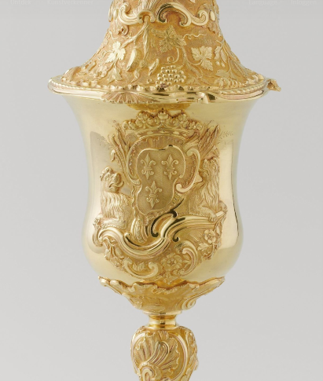
© The coat of arms on the gold presentation cup, 1743, unknown maker, Collection of the Rijksmuseum, Amsterdam, inv. no. BK-1970-40.
Provenance
Private collection, France
Makers mark of Willem Cornelis Snijder 1687-1705. (Haarlem, circa 1700)
Dimensions
Height 11 cm.
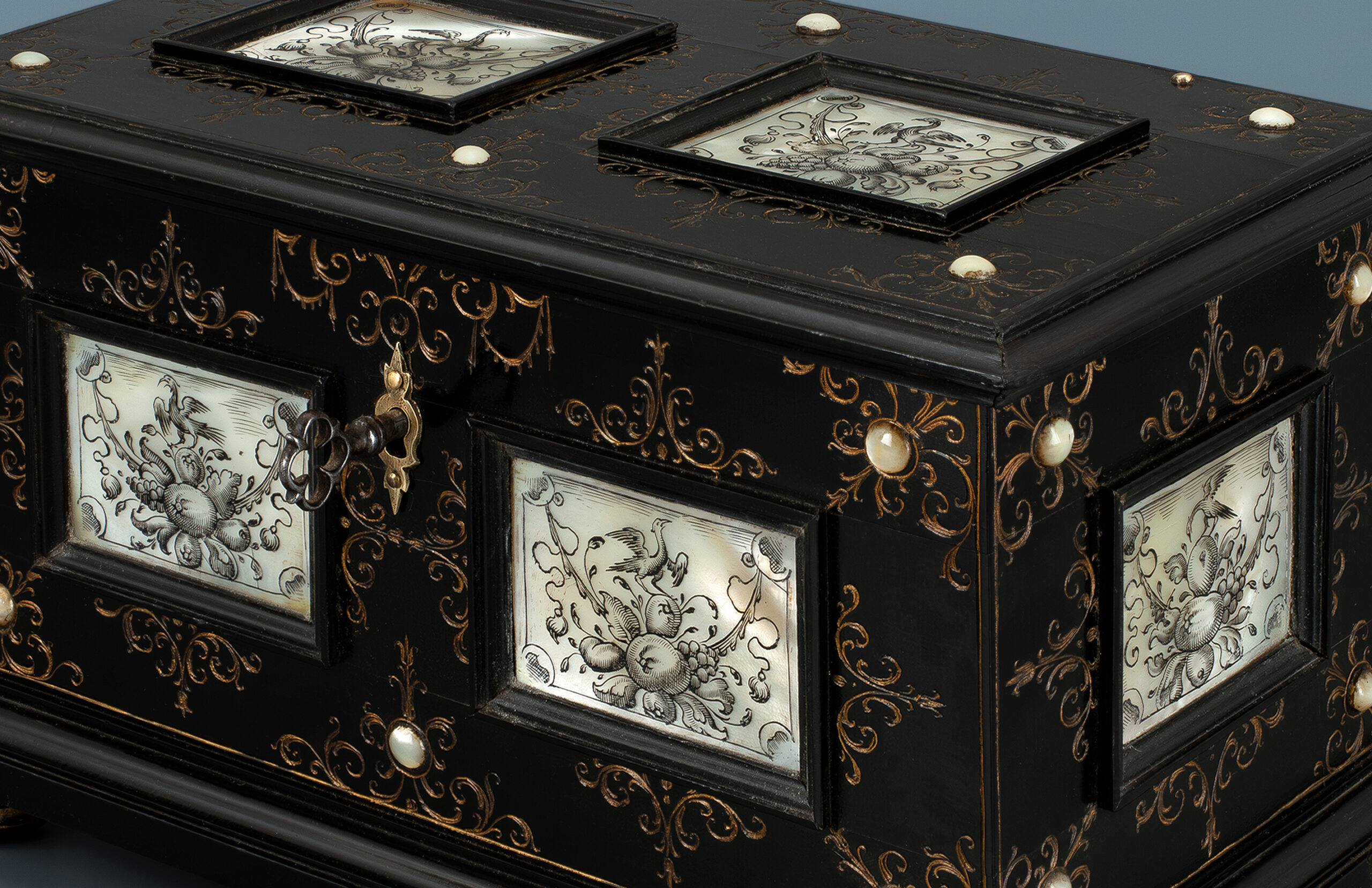
This jewellery casket is decorated with mother-of-pearl plaquettes and cabochons. The ebony is embellished with engraving in gold….

A trumpet shaped engraved silver beaker, the slightly spreading base with reeded and corded rims, the upper part…

The cup engraved with flowers and foliage above flower bandwork, the lower rim of the cup with engraved…