The Heilige Geest Silver-Gilt Cup
A silver-gilt, finely embossed presentation cup with lid, richly decorated with fruit motifs and acanthus leaves. The lid…
Of oblong section, the hinged covers with silver overlay on a gold ground pierced with monkeys, vases with flowers, winged sphinxes, fruit festoons and birds amongst scroll work surrounding a central medallion with a biblical scenes, with pierced clasp with push button, opening to reveal a later German calendar and several notebook pages, the spine with four ribs dividing it in three sections, all engraved with scrollwork, a monkey, and floral motifs.

Small silver book bindings from the Dutch Republic’s province of Holland, dating from the first quarter of the 17th century are extremely rare. The main characteristics of such bindings are that they all have a relatively small size and appear to be unmarked; their decoration seems to be inspired by the ornament prints produced and distributed by Theodor de Bry (1528 Liège – Frankfurt 1598) and his son Johann Theodor de Bry (1561 Strasbourg – Bad Schwalbach 1623). The binding’s elaborate decoration with scrollwork, floral and animal motifs such as monkeys, birds, griffons, sphinxes, fruits and flowers, was undoubtedly inspired by the ornamental print designs produced by the aforementioned and other contemporaries.
The present book binding is decorated in the manner of Theodore de Bry and contains a later calendar of German origin, Verbesserter Calender aufs Jahr 1755, beschrieben von Matthias Rohlfs, Mathem[atiker] Hamburg, gedruckt bey Conrad König, apart from the notebook pages. It is most probably made by an unknown silversmith, active in Amsterdam in the early 17th century. It’s decoration strongly resembles that of a contemporary binding in the collection of the Metropolitan Museum, New York (inventory n° 37.125), where the spine is mounted on the long side, instead of on the short side, as is the case here.
The oval medallions depict Biblical scenes: on the front is the Archangel Gabriel who announces the foreseen birth of Child Jesus to the Virgin Mary, on the reverse we see the Adoration of the Shepherds. Among traditional motifs such as volutes, mascarons, birds, vases with flowers and fruits hanging from ribbons, the monkeys and female, winged sphinxes stand out. The latter are reminiscent of the sphinxes in Collaert’s Juno print (Coll. Rijksmuseum, inventory n° RP-P-1892-A-17390). Whether this print was based directly on the original remains to be seen. There are adjustments, whether or not compositional (the vase on the beast’s head: disappeared; the neck: lengthened). In Collaert’s print and those of predecessors and contemporaries, this type of sphinx wears a hanging covering on its back, sometimes described as ‘a kind of saddle.’ The oldest known examples originate from Italy and were copied by, among others, the aforementioned Johann Theodor de Bry, but the most similar is a sphinx by Étienne Delaune. That the silversmith did not understand the print at all is evident from the wings that do not originate from the shoulders, just in front of the covering, but from the covering itself.
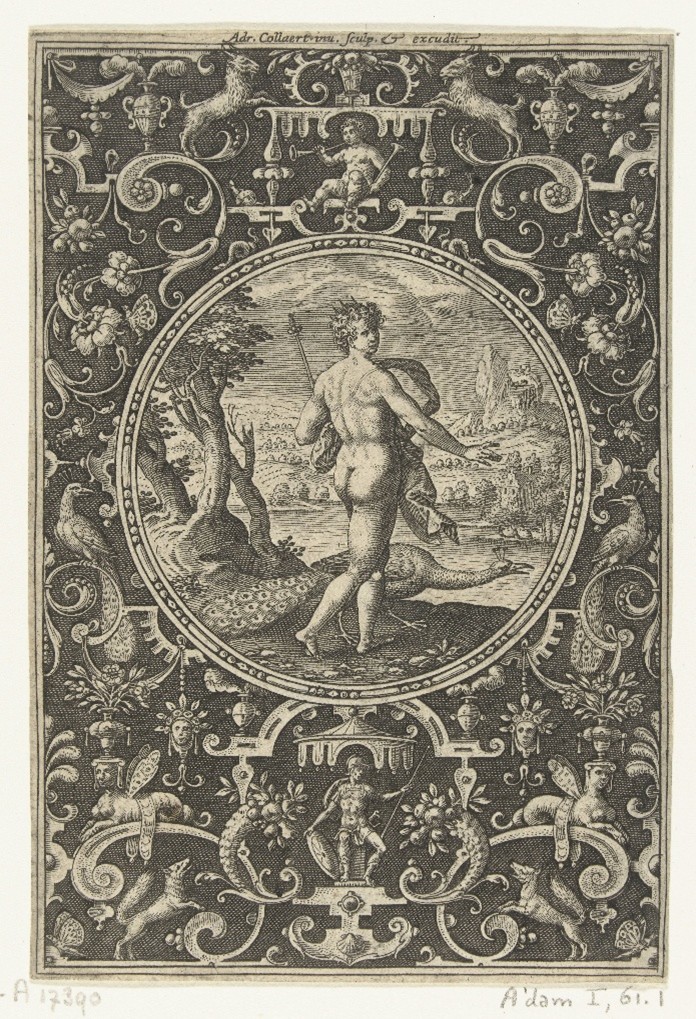
© Collection Rijksmuseum, Print room, inventory n° RP-P-1892-A-17390, medallion of Juno and the peacock, by Adrieaen Collaert
The technique of cutting away precious metal by sawing probably was not extant during earlier periods. However, other techniques such as drilling, chiselling and polishing were applied more and more during the course of the 17th century. The designs of the ornamentation of these bindings seem to have been inspired by prints by the goldsmith, printmaker and publisher Theodor de Bry and often comprises flower and fruit festoons, animals, birds, caterpillars, masks, sphinxes, etc. All bindings are of small size and lack identification marks. It is commonly assumed that they were manufactured in the Northern Netherlands. For the greater part they contain books with a religious, often Protestant content, but some are known with a profane character, such as the silver binding holding a Liber amicorum for the newlywed couple Van Loon-Ruychaver, acquired by the Museum van Loon, Amsterdam, in 2009. In some cases their content was a notebook, its binding provided with a fastening and key and an inserted stylus.

On all comparable bindings the hallmarks are absent. It is not quite clear why. According to the guilds’ statutory regulations and decrees of the period, a silversmith had to strike his mark on each work before delivering it to the Assay Office, where, after acceptance, the town mark and year mark were struck. Prof. Dr Johan ter Molen gives a plausible hypothesis for the absence of the marks. He argues that there was very little enthusiasm with both patron and silversmith to take such a vulnerable object to the Assay Office. In order to be able to capitalise on heavy objects by getting at least the value of the investment in silver in return, such pieces, naturally, needed a guarantee of quality given by the Assay Office. However, for lighter objects, such as these bindings, with their relatively low weight and with their often religious function, the wealthy owner(s) would rarely have considered melting the piece down to regain the value of the silver invested. For this reason the interest for hallmarking such pieces may have been absent.
Associated Literature
Cf. J.W. Frederiks, Dutch Silver, vol. II, Wrought Plate of North and South Holland, Martinus Nijhoff, The Hague, 1958, n° 181, p. 64, ill. pl. 54, and other examples, n°s 182-185, 189, 194 and 195, p. 64-65, ill. pl. 54-55 and n°s 194 and 195, p. 69, ill. pl. 58, and n° 244, p. 85, ill. pl. 78.
Cf. Dr J.R. ter Molen, Zilver, Catalogus van de voorwerpen van edelmetaal in de collectie van Museum Boijmans-van Beuningen, Rotterdam, 1994, n° 4, p. 58, ill. p. 59
Cf. Bernie Vervoort, An Early Seventeenth-Century Silver Binding Manufactured in the Province of Holland, the Decoration Influenced by De Bry, in Quærendo, 2015, p. 144-156
Amsterdam, circa 1600-1620

A silver-gilt, finely embossed presentation cup with lid, richly decorated with fruit motifs and acanthus leaves. The lid…

A finely engraved brandy bowl, of octagonal form, the bowl standing on a domed conforming foot chased with…

From a small oak cabinet datable to around 1700 a group of various objects looks at us. The…